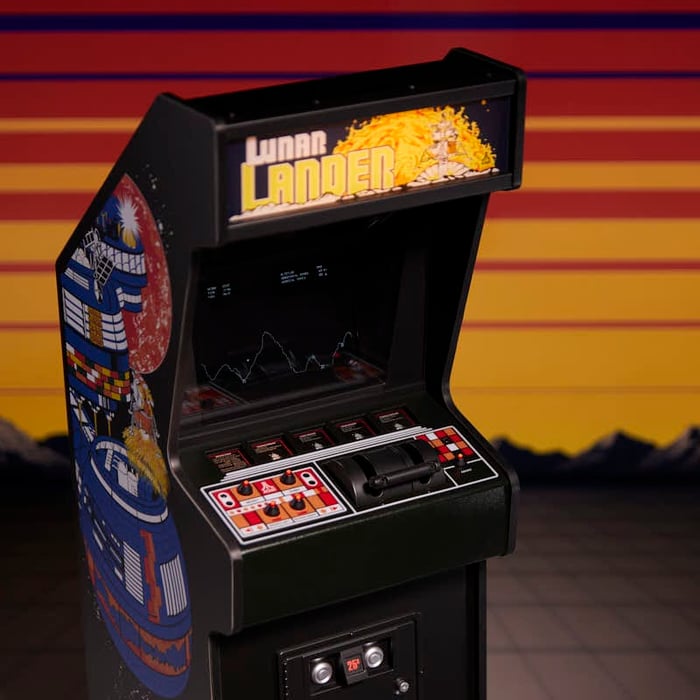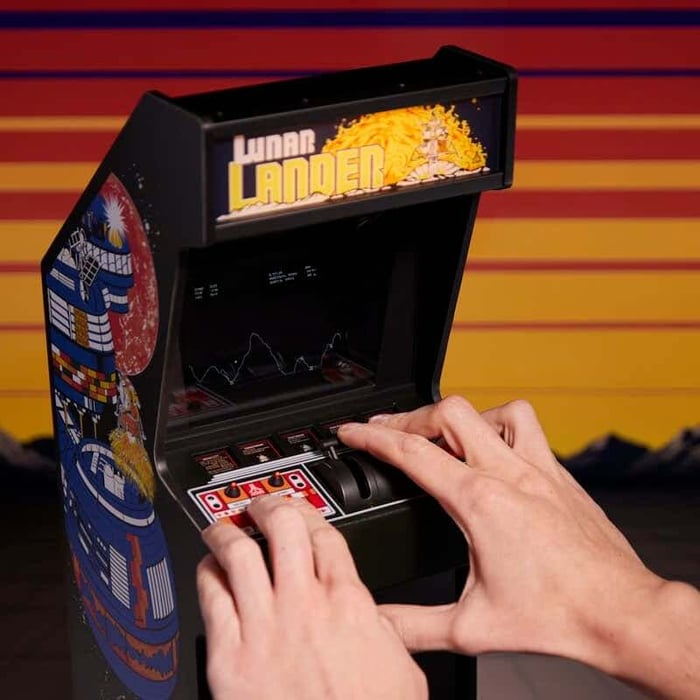






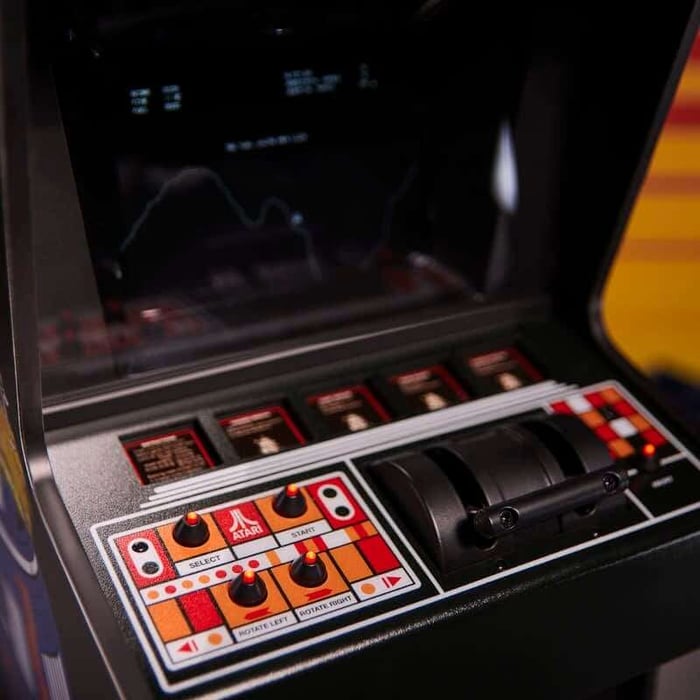

Before photorealistic graphics and endless tutorials, games trusted you to figure things out the hard way. Lunar Lander was one of those games. No music. No hand-holding. Just gravity, thrust, and the constant risk of crashing into the moon. When Atari released Lunar Lander in arcades in 1979, it felt different. Quiet. Technical. Almost intimidating.
Today, that same experience returns in quarter arcade form, and it still holds up. In this article, you will discover why Atari Lunar Lander remains such an important part of gaming history, what makes the quarter arcade version special, and why collectors still gravitate toward this understated classic.
Key takeaways
Atari Lunar Lander introduced physics-based gameplay long before it was common
The quarter arcade format preserves the original challenge and presentation
Lunar Lander stands out as a thinking game in a genre dominated by reflexes
The origins of Atari Lunar Lander
Lunar Lander arrived at a unique moment in history. Space exploration was still fresh in the public mind. The Apollo missions had ended only a few years earlier, and interest in space science was high.
Atari’s Lunar Lander was one of the first arcade games to use vector graphics. Instead of pixels, it used clean lines that gave the game a technical, almost scientific look. That choice was not just visual. It reinforced the feeling that you were piloting a machine, not controlling a character.
Key foundations of the game include:
Realistic gravity and momentum
Fuel management as a core mechanic
A calm, minimalist presentation
According to the Strong National Museum of Play, Lunar Lander is recognised as one of the earliest examples of physics-based gameplay in arcades.
Why the gameplay feels timeless
Lunar Lander does not rely on speed or spectacle. It relies on judgment. Every movement matters because fuel is limited and gravity never stops.
The controls are simple, but mastery takes time. You learn to feather the thrust. You learn patience. Failure feels fair because it is always your decision that causes the crash.
What makes the gameplay endure:
Clear cause and effect between input and outcome
Increasing tension as fuel runs low
A skill curve that rewards practice rather than memorisation
Unlike many arcade games of its era, Lunar Lander feels almost meditative. That quality makes it surprisingly refreshing today.
What makes the quarter arcade version special
The Atari Lunar Lander quarter arcade recreates the original cabinet experience at a smaller scale. This is not a reinterpretation. It is a preservation.
You still get the distinctive vector-style visuals. You still manage thrust and fuel with precision. The controls feel deliberate, which matters for a game built around physics.
Why collectors value the quarter arcade format:
Authentic gameplay without emulation menus
Compact size that suits modern spaces
Strong visual presence despite its simplicity
At Just Geek, quarter arcades appeal to collectors who want playable history rather than purely decorative pieces. Lunar Lander fits that philosophy perfectly.
Common misconceptions and how to approach the game
Some players assume Lunar Lander is too slow or too difficult. In reality, it is about mindset.
This is not a game you rush. It rewards calm decision-making. If you treat it like a reflex-based arcade title, you will struggle. If you slow down, it clicks.
Practical tips for first-time players:
Focus on vertical speed before horizontal movement
Use short bursts of thrust instead of holding it
Accept early crashes as part of learning
Once you adjust your expectations, the game becomes deeply satisfying.
Lunar Lander in the wider arcade landscape
Most classic arcade games are loud and competitive. Lunar Lander is neither. That contrast is exactly why it stands out.
According to Atari's historical archives, Lunar Lander was among the first arcade games to experiment with variable scoring based on player decisions rather than fixed objectives.
This design approach influenced later simulation and strategy games. It showed that arcades could support thoughtful play, not just fast reactions.
In today’s collecting landscape, this makes Lunar Lander feel mature and distinctive. It appeals to collectors who value innovation and design history as much as nostalgia.
Why experienced collectors still seek it out
From an expertise perspective, Lunar Lander represents a turning point. It blends engineering concepts with entertainment. Few games of its era took that risk.
Collectors often prioritise pieces that mark a shift in design thinking. Lunar Lander does exactly that. It introduced physics, restraint, and consequence into a space dominated by action.
As someone deeply involved in gaming and quarter arcades, this is the kind of title that rounds out a collection. It balances louder games. It invites conversation. It rewards repeat play.
Conclusion
Atari Lunar Lander is iconic because it trusted players to think. It respected intelligence at a time when most arcade games chased excitement through noise. The quarter arcade version preserves that spirit while making it accessible to modern collectors.
If you want a piece of arcade history that still feels relevant, Lunar Lander delivers. Take your time. Manage your fuel. And enjoy the quiet tension of a perfect landing.
FAQs
Is Atari Lunar Lander suitable for casual players?
Yes, but it rewards patience. It is easy to start and challenging to master.
Does the quarter arcade version play like the original?
Yes. It preserves the original mechanics and visual style closely.
Why is Lunar Lander considered historically important?
It was one of the first arcade games to use physics-based gameplay and vector graphics.